
For decades, people have been taught that grief is something you carry for the rest of your life. The goal has been to cope with it, manage it, and learn to live around it. If you've accepted that as the only possible outcome, you're not alone. It's what I believed too.
Everything changed when I stopped asking how to live with grief and started asking a different question. What if the problem isn't the grief itself? What if it's the model we've been taught to follow?
That question led me to a completely different understanding of grief rooted in neuroscience, neuroplasticity, and the science of how thoughts create emotions and feelings. It led my children and I to a completely different outcome. Not better coping. Not better management. Complete freedom from the emotional suffering I once believed we'd carry forever.
Today, I help others achieve that same outcome. You don't have to stop loving the person you lost, and you don't have to spend the rest of your life believing that suffering is the price you pay for that love.
The question is... why do two models of grief lead to such different outcomes?

If you've spent any time reading books about grief, listening to grief podcasts, attending grief support groups, talking with grief counselors, grief coaches, grief therapists, or joining online grief communities, you've probably noticed that almost everyone is working toward the same destination. The goal isn't to end grief. The goal is to help you cope with it, manage it, and eventually learn to live around it.
That's because the traditional model of grief is built on the belief that grief is a lifelong extension of love. Within that model, continuing to experience sadness or pain on birthdays, anniversaries, holidays, and other meaningful moments isn't considered a sign that something is wrong. It's considered a normal and expected part of loving someone you've lost and the result of carrying grief.
If you've ever been told you'll always have bad days, that anniversaries will always hurt, that grief never really ends, or that learning to live with the pain is the ultimate goal, you've already been introduced to the traditional model of grief, whether anyone called it that or not.
My work is built on a different destination entirely. I don't believe grief is something you're meant to carry forever. I know it's possible to continue loving someone for the rest of your life without continuing to suffer because they're gone. That doesn't mean forgetting them, leaving them behind, loving them any less, or pretending they never existed. It means recognizing that love and grief are not the same thing, and that one doesn't require the other.
This is why the outcomes are so different. Each model is designed to produce the result it believes is possible. If a model assumes grief is permanent, it will naturally teach you how to manage it. If a model believes healing is possible, it will focus on helping you reach that outcome. Neither model is failing. Each is producing exactly the result it was designed to produce.
Before we talk about neuroscience, thought patterns, the subconscious mind, or neuroplasticity, we first have to understand the destination each model is trying to reach. Because if two people are following different maps, they shouldn't expect to arrive at the same place.
Most people don't realize they're following a grief model at all. They simply assume what they've been taught is the only way to understand grief.
The reason people experience such different outcomes after loss isn't because one group loves more than the other. It's because they're following two fundamentally different models of grief. Each model begins with a different belief, pursues a different goal, and naturally produces a different result.
The question isn't which model is more popular.
The question is which outcome you want for your own life.
One teaches you how to learn to live with grief. The other teaches you how to live without it.
The Traditional Model of Grief
The Healing Model
Neither model is inherently good or bad. Each is built on a different understanding of grief and is designed to produce a different outcome. That's why it's so important to understand which model you're following before deciding which path you want to take. The rest of this page explains why The Healing Model produces a completely different outcome, how it changed my life, and why I know it can change yours too.
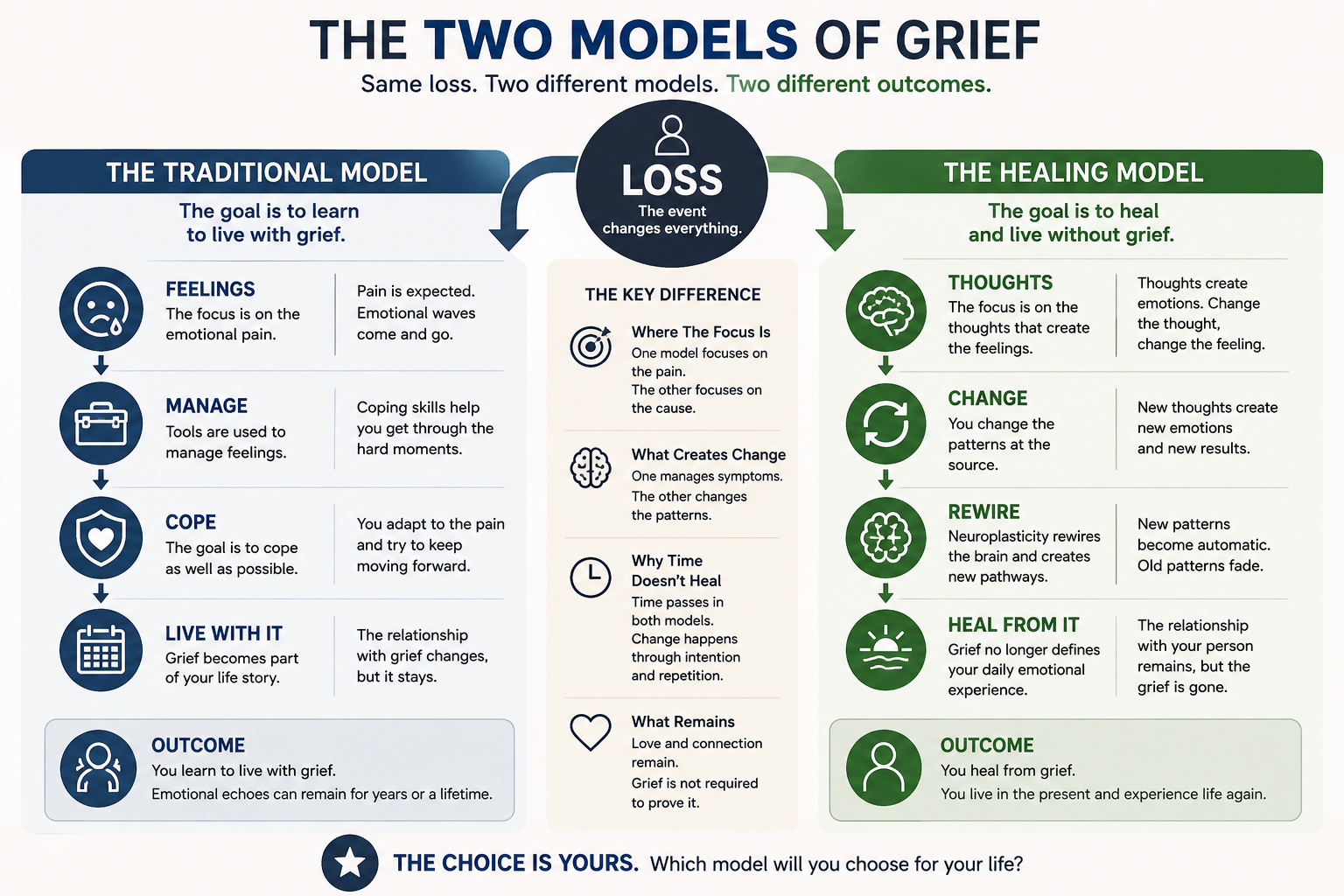
Most approaches to grief focus on the emotional pain people experience after a loss. The Healing Model focuses on what creates that pain in the first place.
Thoughts Create Emotions
Basic neuroscience shows us that every emotion begins with a thought. When the same thoughts are repeated over and over, they strengthen neural pathways in the brain and corresponding responses in the nervous system.
The Subconscious Doesn't Think. It Repeats
Over time, those repeated thought patterns become automatic programs that run through the subconscious mind without conscious effort. This is why the same memories, the same dates, the same places, and even the same songs can continue producing the same emotional response years after a loss. The brain isn't choosing grief. It's repeating The Grief Pattern it learned through repetition.
Neuroplasticity Makes Change Possible
Neuroplasticity is the brain's ability to change, adapt, rewire, and build new neural pathways throughout your life. The same process that learned The Grief Pattern can also unlearn it and learn a new one. When you intentionally change the thoughts you repeat, you begin changing the emotional patterns your brain produces. As those new pathways become stronger, the old ones become weaker through lack of use.
The Subconscious Learns Through Repetition
The subconscious mind doesn't decide whether The Grief Pattern is helpful or harmful. Its job is to automate whatever you repeat most often. That's why time alone doesn't create healing. Time passes whether your thoughts change or not. The brain changes through repetition, not calendars, dates, or coping.
Why The Outcomes Are Different
This is why two people can experience the same type of loss and arrive at completely different outcomes. It's also why two people can spend years following different grief models and experience two completely different futures. The model you follow determines what you practice, and what you practice determines what your brain becomes better at predicting and producing.
How The Healing Model Creates Change
The Healing Model doesn't teach you to suppress your emotions, avoid triggers, or pretend your loss didn't happen. It teaches you how to understand The Grief Pattern that creates emotional suffering and how to intentionally change it. When the patterns change, the emotional experiences change too. That's why the goal isn't simply to feel better. The goal is to create lasting change by rewiring the patterns that create emotional suffering in the first place.

Everything you've read so far explains the science behind why people experience different outcomes after loss. This isn't something I learned in a classroom. It's something I discovered because my own life depended on finding a different answer.
In June of 2015, Larissa, my soulmate and mother of my two children, died by suicide. Overnight, the life we'd spent twenty six years building together disappeared. Like most people, I followed the only grief model I'd ever been taught. I believed the pain was something I would carry for the rest of my life. I believed the goal was to cope, manage it as best I could, and somehow learn to live around it.
For the next five years, that's exactly what I did. I survived. I replayed the same thoughts every day. My brain became better at producing the same fear, the same hopelessness, and the same emotional suffering because it kept repeating The Grief Pattern. My children followed the same model because it was the only one they saw.
Then I stopped asking how to live with grief and started asking a different question. What if the model was wrong? That single question changed everything.
As I began studying neuroscience, neuroplasticity, the subconscious mind, and how repeated thoughts shape emotional experience, I realized I wasn't trapped by the grief. I was trapped by The Grief Pattern my brain had practiced thousands of times.
When I intentionally changed that pattern, my emotional experience began to change too.
Today, I don't grieve. I still love Larissa. I always will. But love and grief are not the same thing. My children healed too. The relationship we have with Larissa didn't disappear. The emotional suffering we attached to her did.
That's why I teach The Healing Model. I don't teach it because I believe it works. I teach it because I lived it. My children lived it. My clients continue to prove it every day.
I didn’t just heal from the grief, but my anxiety too. I started sleeping through the night again. I feel like I’m finally living again, not just surviving, not just going through the motions. I am able to be there for my children.Pete
Your method is straight-forward and doesn’t enable limiting thoughts that keep the pain alive. I was in traditional therapy and it just validated all my sad feelings... I was aware of my pain and I needed to evolve. I wanted to live again and that’s what your program offers.Amber
By now, you've seen that The Healing Model isn't about learning to cope with grief. It's about understanding how The Grief Pattern is created, why it continues long after the loss, and how to intentionally change it. That's exactly what we work on together.
This isn't a program built around talking about your loss week after week or simply waiting for time to pass. Each week builds on the last, giving you practical tools and a clear understanding of how your brain, subconscious mind, and nervous system work together to create emotional experiences. As you begin applying those tools consistently, you begin changing The Grief Pattern that has been keeping you stuck.
Because every person's story is different, I don't teach from a rigid script. I meet you where you are, identify the patterns that are keeping your grief alive, and guide you through the process of replacing them with healthier ones. Whether you've been grieving for six weeks or twenty years, the process is always focused on creating lasting change rather than temporary relief.
Your 12 Week Life After Loss Coaching Program Includes
My goal isn't to help you feel better for a few hours after each session. My goal is to help you create permanent changes that continue long after our work together is complete.
If you've spent enough time trying to live with grief and you're ready to discover what life without grief can look like, then you're ready for The Healing Model and my 12 Week Life After Loss Coaching Program.